
USB-C keychain flashlight: what really matters when choosing one
Lumens, candela, IP54 or IP66 and a USB-C plug: what the numbers on keychain flashlights mean and which models illustrate them.
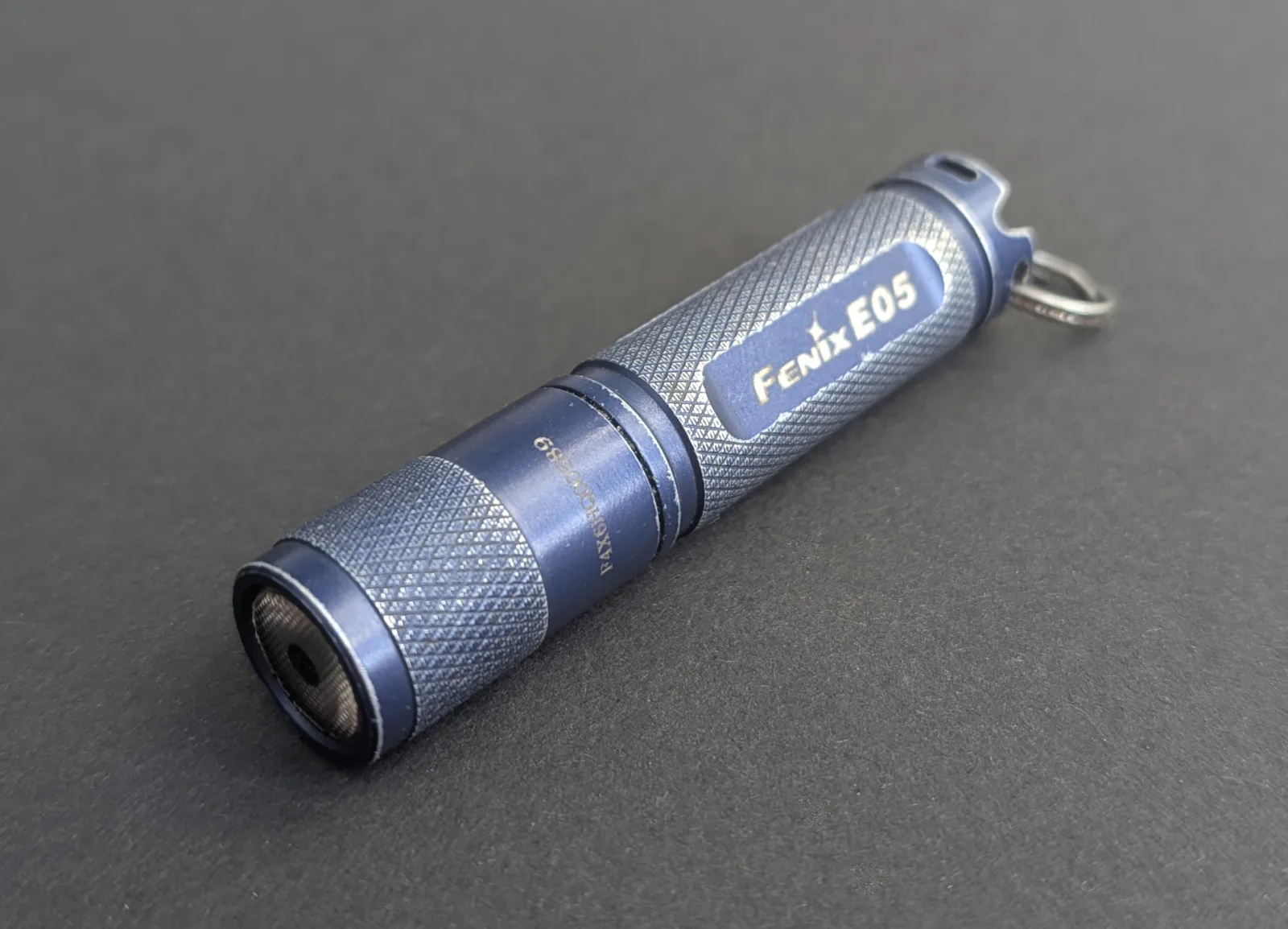
A keychain flashlight is one of those things that seems pointless until you are hunting for a keyhole on a dark staircase, a coin under the car seat or the way back to your car across a dark parking lot. Your phone has a flash, of course, but using it quickly drains the battery of the device you need for everything else. Modern keychain lights are surprisingly capable: according to their makers, the strongest reach several hundred lumens, weigh around twenty grams and charge over the same USB-C cable as your phone. The packaging, however, is full of numbers that don't tell the whole story. In this guide we explain what they mean and what to look out for when buying, using models and figures from official specifications and retail sources.
Lumens, candela and what ANSI FL1 means
Most serious manufacturers quote figures according to ANSI FL1, a standard published by the American National Standards Institute in 2009. It is voluntary and defines how a flashlight's basic properties are measured, so numbers from different brands are at least roughly comparable:
- Luminous flux (lumens) tells you how much light the flashlight emits in total. It doesn't tell you where that light goes.
- Luminous intensity (candela, cd) is measured at the brightest spot of the beam. A high value means a narrow, far-reaching beam.
- Beam distance is the distance at which the light falls to 0.25 lux, roughly the light of a full moon on a clear night.
- Runtime is measured until intensity drops to 10 percent of the value recorded 30 seconds after switching on.
- Impact resistance is tested by dropping the flashlight in six different orientations, after which it must still work.
With small lights, the key point is that the maximum figure almost always refers to Turbo mode. In its round-up of keychain lights, The Gadgeteer notes that the headline number is only a brief burst that the light holds for a short while before automatically stepping down so it doesn't overheat. In such a tiny body there is simply nowhere for the heat to go. For everyday use, the medium modes and the lowest "moonlight" mode, which you will use most often, matter more.
An example: the Nitecore TINI 3 is officially rated at 600 lumens, 2,050 candela and 90 meters of throw, and its longest runtime is 85 hours, but only at 1 lumen. Both figures are true; they just don't apply at the same time.
Battery and charging: not every plug is USB-C
Almost all new keychain lights have a built-in lithium-ion battery that you cannot replace. Capacity is modest, so the numbers are worth a look:
- Nitecore TIKI: 130 mAh, charging over USB-C in about 1 hour 20 minutes,
- Nitecore TINI 3: 330 mAh, charging over USB-C in about 1 hour 30 minutes (with a 5 V/2 A adapter),
- Fenix E03R V2.0: 400 mAh and USB-C,
- Nitecore TIP3: 650 mAh and USB-C, according to The Gadgeteer.
Olight takes two different routes. The iMini 2 has no buttons: it turns on when you pull it out of its magnetic cap, which houses a built-in USB-A plug. So you don't charge it with your phone cable; you plug it straight into a charger or a computer with a USB-A port, which new laptops often no longer have. The newer Olight iUltra has a built-in USB-C plug under a cover; Notebookcheck lists 80 lumens, 28 meters of throw, a 10180 battery rated at 0.3 Wh, about 50 minutes of runtime and an hour to recharge.
The advantage of a built-in battery is that you never open the flashlight, which makes it easier to seal properly. The downside is that the battery weakens over the years and can't be swapped. Older lights such as the Fenix E05 in our photo use an AAA battery you can buy at any gas station, but without USB-C charging.
Water, dust and drops: IP54 is not IP66
The IP rating under IEC 60529 (EN 60529 in the EU) has two digits. The first indicates protection against solid particles, the second against water:
- 5 in first place means dust protection (some dust may get in, but not enough to affect operation), 6 means fully dust-tight,
- 4 in second place means protection against splashing from any direction, 6 against powerful water jets, 7 against immersion up to 1 meter, and 8 against deeper immersion under conditions set by the manufacturer,
- X means no rating is given for that category, not necessarily that there is no protection.
In practice: the TINI 3 and TIP3 are rated IP54, which is enough for rain but not for a drop into a puddle or sink. The TIKI and Fenix E03R V2.0 are rated IP66 and can withstand a powerful jet of water. According to Notebookcheck, the Olight iUltra carries an IP6X rating, so it is fully dust-tight, but there is no water rating.
For drops, manufacturers state a height: 2 meters for the TINI 3 and TIP3, 1 meter for the TIKI, and also 1 meter for the Fenix E03R V2.0 according to The Gadgeteer. For a light that hangs on your keys and gets tossed onto a table every day, that figure matters more than it seems.
Five models that illustrate the choice
The prices below are US retail prices quoted by The Gadgeteer in November 2026. Prices change often, so check them before you buy.
- Nitecore TINI 3 ($39.95): 600 lumens, 20 grams, an OLED display showing brightness and remaining runtime, and three color temperatures (3,000, 4,500 and 6,500 K). It has a lockout against accidental activation in your pocket. The "smartest" of the bunch, but only IP54.
- Nitecore TIP3 ($34.95): 720 lumens, 30 grams, a bigger battery and a pocket clip. Suited to people who genuinely use a flashlight a lot.
- Fenix E03R V2.0 ($30.95): 500 lumens, 30 grams, a metal body, IP66, an additional red light (5 lumens) that is kinder to night vision, and a faint locator glow.
- Nitecore TIKI ($19.95): just 12 grams and 300 lumens, with an auxiliary high color rendering light (CRI 90+) and a 500-milliwatt UV light at 365 nm.
- Olight iMini 2 ($19.99): only 50 lumens and 21 meters of throw, but no buttons and a magnetic cap. A light for emergencies, not for a walk in the woods.
For most people a light with 300 to 600 lumens, at least one very low mode and a lockout is enough. If you carry it in your pocket with your keys, a lockout is almost essential: accidentally triggering Turbo can drain the battery and heat the flashlight up.
Our subjective take
A keychain flashlight is a rare piece of tech where $20 to $40 buys a genuinely good product. The biggest mistake people make is buying on the highest lumen figure, even though they will use Turbo a few times a year and low or medium output every day. A lockout, USB-C, good IP protection and the lowest possible low mode convince us more than 600 or 720 lumens.
If we were choosing today, we would take the TIKI or the Fenix E03R V2.0 for everyday use, because both are well protected against water and light in weight, while the TINI 3 is for those who like gadgets with a display. The Olight iMini 2 is charming, but in 2026 a USB-A plug is more of a hindrance than a help.
This is the subjective view of The Pocket Brief editors.
Sources
Was this helpful?
Be the first to recommend this.
Keep reading

A tracker for your keys and bag: AirTag, Pixel Tag, SmartTag3 or Chipolo?
With trackers, the casing matters less than your phone and its network. What AirTag, Pixel Tag, Galaxy SmartTag and Chipolo offer, and where you can buy them.
Power banks on planes: what applies in 2026 and why you can no longer charge them in flight
Since March 2026 you may carry at most two power banks and must not recharge them on board. How to work out Wh and what Lufthansa, Wizz Air and Emirates require.

IP55, IP67 or IP68: what water resistance ratings really mean for earbuds and trackers
We wear earbuds, trackers and watches in the rain and to the gym. What the two IP digits mean, why IP67 isn't always better than IP66 and where protection ends.
